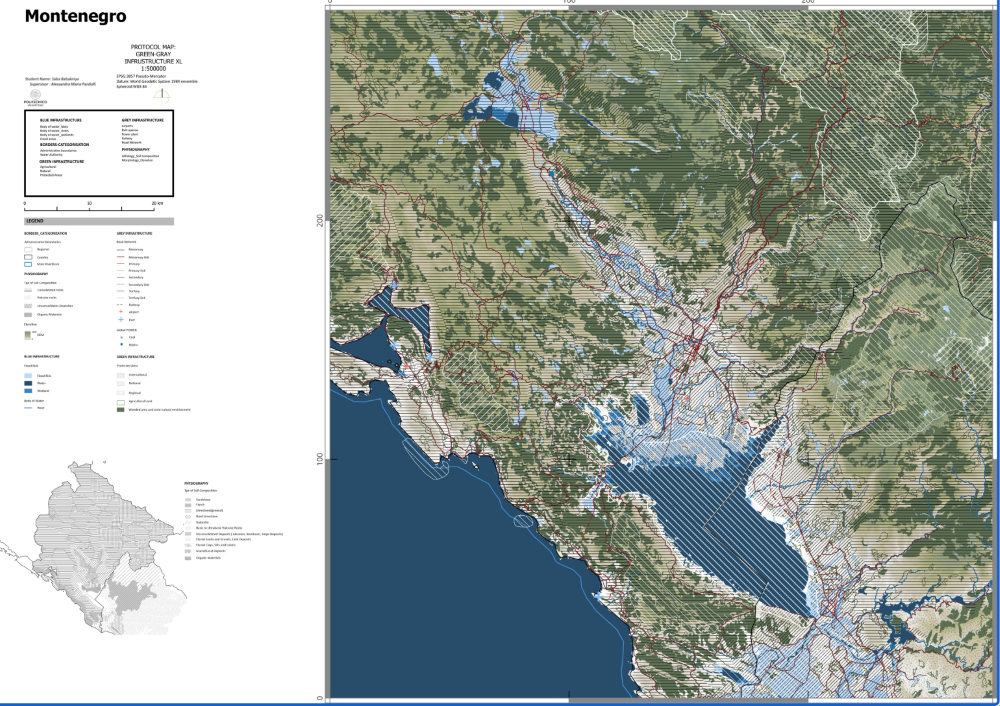
Montenegro is facing an accelerating territorial imbalance marked by the depopulation of rural regions, ecological degradation, and urban expansion driven by speculative development. In this fragile context, agriculture—historically a backbone of national identity and economic productivity—has become increasingly vulnerable to climate change, market fluctuations, and the pressure of urban growth.
This thesis responds to these conditions through an integrated spatial and ecological strategy aligned with Montenegro’s National Smart Specialisation Strategy (NS3), which prioritises sustainable agriculture, digital innovation, and circular economy as key drivers of future development. By positioning agriculture not as a residual land use but as a technological and ecological infrastructure, the project explores how hydroponic and regenerative systems can act as mediators between urban and rural, ecological and industrial domains.
The research unfolds across multiple scales:
– At the XL scale, territorial analysis interprets Montenegro through its ecological corridors, floodplains, and productive valleys, identifying the Podgorica–Zeta plain as a key hinge between the Adriatic and inland systems.
– At the L and M scales, spatial mapping and protocol analysis (Green-Grey, Borders, and Ecosystem Services) reveal the tension between fertile agricultural soils, infrastructural nodes, and fragmented governance.
– Finally, at the S scale, the study focuses on the southern periphery of Podgorica, between the airport and railway station—an area where agricultural land, industrial edges, and hydrological systems overlap.
The thesis is defended at Politecnico di Milano – Piacenza campus.